


The main change is clear. The 2026 FIFA World Cup will feature 48 teams instead of 32. Those teams will be divided into 12 groups of four, and the tournament will include 104 matches in total. That means more games, more nations, and more possible qualification scenarios than in previous editions.
For many readers, the biggest questions are these. How do the World Cup 2026 groups work? What is the new Round of 32? And how do the best third-placed teams qualify? These are important questions because the new structure changes both the group stage and the knockout stage.
In this article, we explain the World Cup 2026 format step by step. We will look at the groups, the qualification process, the new knockout bracket, and why this bigger format will make the tournament feel different from the first match to the final.
Table of Contents
How Do the World Cup 2026 Groups Work?
Why the World Cup 2026 Has 12 Groups
How Best Third-Placed Teams Qualify at World Cup 2026
What Is the Round of 32 in World Cup 2026?
How Many Matches Are in World Cup 2026?
Why the New World Cup 2026 Format Is Important
World Cup 2026 Key Dates and Tournament Structure
Final Thoughts
Frequently Asked Questions
World Cup 2026 Format at a Glance
The 2026 FIFA World Cup will feature 48 teams. Those teams will be split into 12 groups of four. Every team will play three group-stage matches, just like in recent World Cups. After that, the top two teams in each group will qualify automatically. The eight best third-placed teams will also go through, which means 32 teams will reach the knockout stage.
That knockout stage now begins with the Round of 32. After that come the Round of 16, quarter-finals, semi-finals, third-place match, and final.
So if you want the simplest possible explanation, it is this: the World Cup 2026 format is still built around a group stage and a knockout stage, but both parts are now bigger than before.
| World Cup Format Area | Previous Format | World Cup 2026 |
|---|---|---|
| Teams | 32 | 48 |
| Groups | 8 groups of 4 | 12 groups of 4 |
| Matches per Team in Group Stage | 3 | 3 |
| Teams Advancing from Groups | Top 2 only | Top 2 + 8 best third-placed teams |
| First Knockout Round | Round of 16 | Round of 32 |
| Total Matches | 64 | 104 |
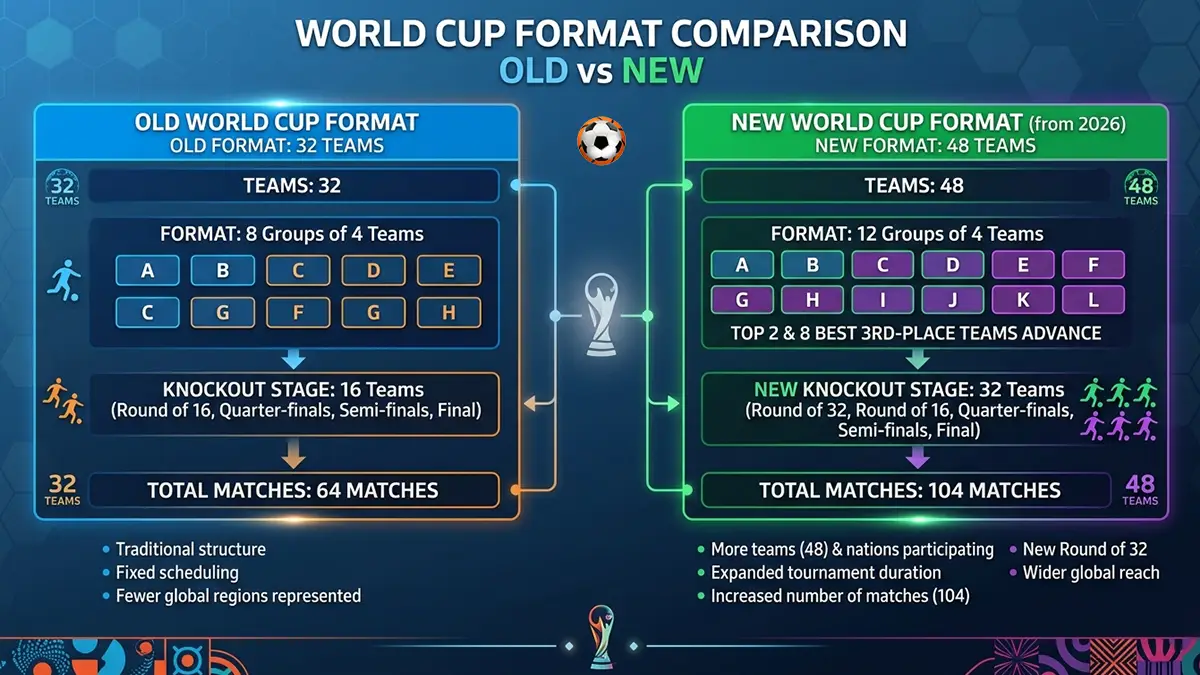
This comparison already shows why so many fans are searching for a World Cup 2026 format explained guide. The new structure is not difficult, but it is different enough that many people want a quick and clear breakdown before the tournament begins.
How Do the World Cup 2026 Groups Work?
Points are awarded in the standard way. A win gives three points, a draw gives one point, and a loss gives zero. At the end of the group stage, the teams in each group are ranked from first to fourth.
The top two teams in each group qualify automatically for the knockout stage. That is the easy part to understand. The extra layer is that third place may also be enough. In the 2026 tournament, eight of the 12 third-placed teams will also qualify.
This changes the feeling of the group stage. In older World Cups, many teams knew that third place was simply not enough. In 2026, third place can still bring qualification. That means more teams are likely to stay alive deeper into the group phase.
It also means that late goals, goal difference, and narrow defeats may matter more than usual. A team that loses one match by a single goal may still be in a much better position than a team that loses heavily. In that sense, the World Cup 2026 groups are not just about winning the group. They are also about managing risk and staying competitive across all three matches.
Why the World Cup 2026 Has 12 Groups
If you keep groups of four and expand to 48 teams, you naturally end up with 12 groups. This also allows every team to play three matches, which is seen as a fair and balanced way to start the tournament. A team gets enough time to recover from one bad result, and the group does not become too short or too random.
There was earlier discussion around possible groups of three, but the final structure kept groups of four. That is probably easier for fans to follow and easier for teams to prepare for. Most football supporters already understand how a four-team group works.
So while the number 12 may look unusual at first, the logic behind it is simple. FIFA wanted a larger World Cup, but still wanted teams to play three group matches in a familiar mini-league format. That is why the World Cup 2026 groups are set up the way they are.
How Best Third-Placed Teams Qualify at World Cup 2026
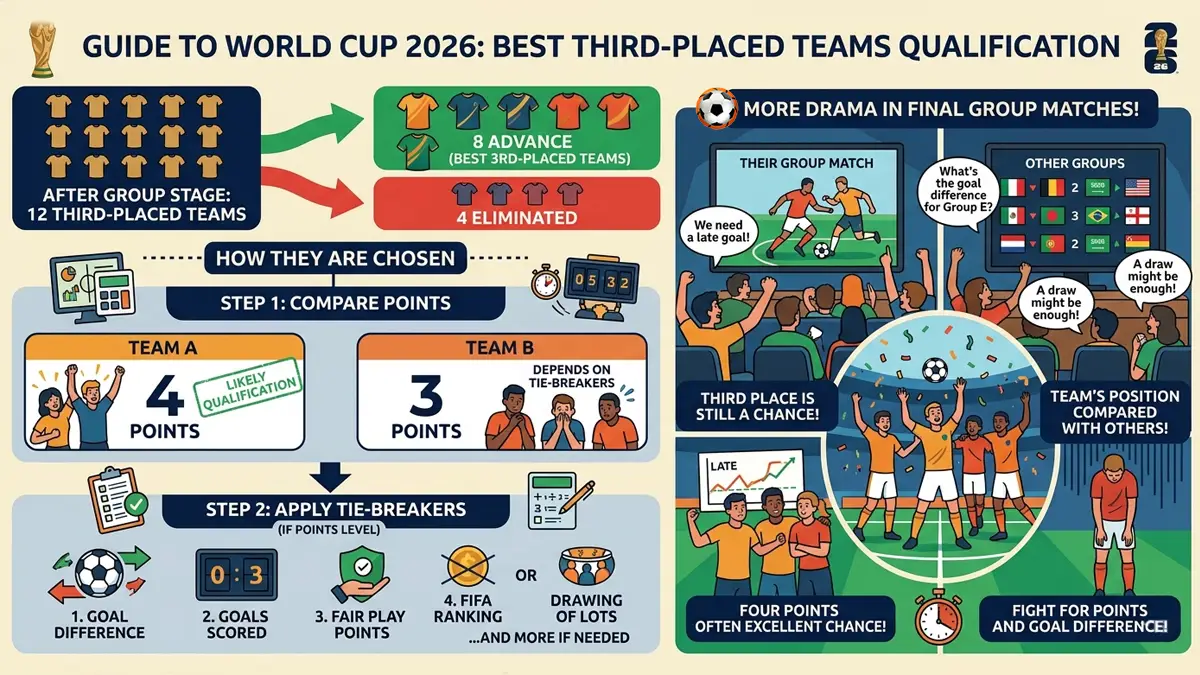
At the end of the group stage, 12 teams will finish in third place. However, only eight of those 12 teams will move on. These are called the best third-placed teams.
So how are they chosen? First, FIFA compares the points won by each third-placed team. If some of those teams are level on points, then tie-breakers such as goal difference and goals scored help decide who ranks higher.
This means third place is no longer just a dead end. It can still be a winning position if the numbers are strong enough. A team with four points in third place may have an excellent chance to qualify. A team with three points might still have hope, but goal difference could become critical.
That is why the World Cup 2026 format should create more drama in the final round of group-stage matches. Teams will not only be watching their own group table. They may also need to compare their position with third-placed teams from other groups.
For fans, this makes the tournament more complex but also more exciting. For teams, it means there is still something to fight for even if first or second place becomes difficult. A draw, a late equaliser, or a smaller losing margin could end up deciding whether a team stays in the tournament or goes home.
What Is the Round of 32 in World Cup 2026?
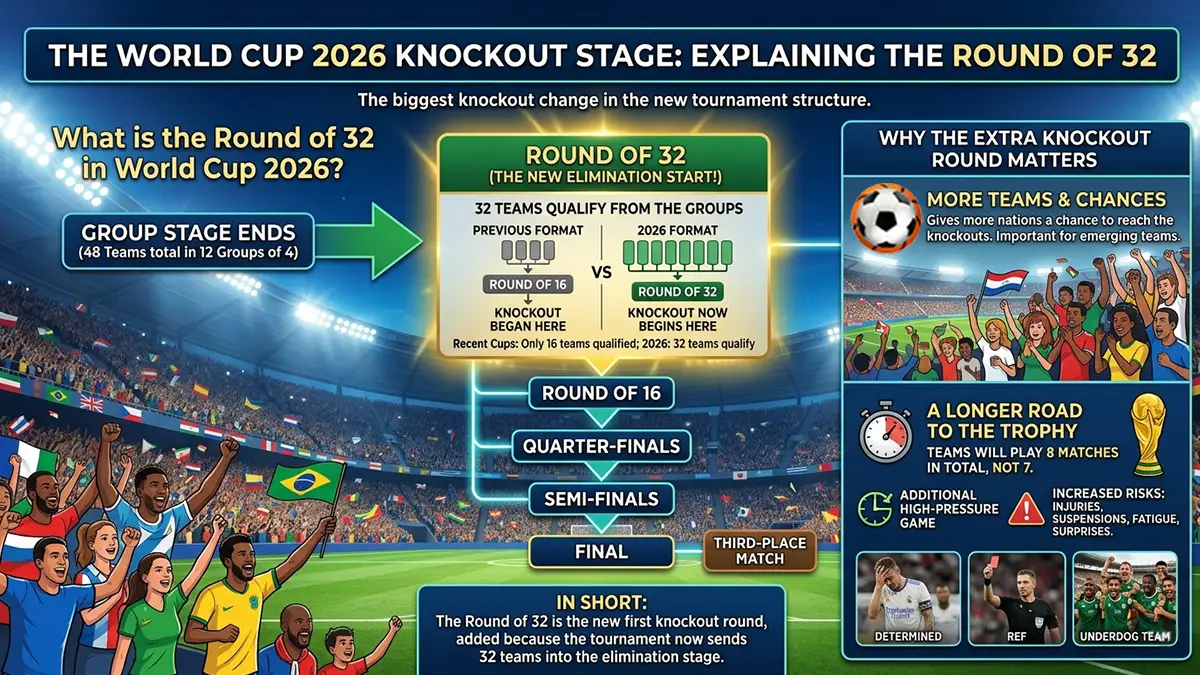
In recent World Cups, the knockout phase started with the Round of 16 because only 16 teams qualified from the groups. In 2026, 32 teams will qualify from the group stage. That means the knockout stage must begin one round earlier.
So once the group stage ends, the tournament moves into the Round of 32. From there, it follows a normal knockout path:
Round of 16
Quarter-finals
Semi-finals
Third-place match
Final
Second, it makes the road to the trophy longer. Teams that reach the final will play eight matches in total, not seven. That adds one more high-pressure game and one more chance for injuries, suspensions, fatigue, or surprises to shape the story of the tournament.
So if someone asks, “What is the Round of 32 in World Cup 2026?” the short answer is easy: it is the new first knockout round, added because the tournament now sends 32 teams into the elimination stage.
How Many Matches Are in World Cup 2026?
The 2026 FIFA World Cup will feature 104 matches in total. Of those, 72 will be played in the group stage. That is a major increase from the older 64-match World Cup format.
This is important because it changes the rhythm of the tournament. There will be more football almost every day, more nations involved, and more matchdays where the standings can move quickly.
It also means there will be more storylines. There will be more games to preview, more teams to follow, and more chances for the tournament to develop in unexpected ways. For football websites, media outlets, and betting communities, the larger match count creates much more space for content and analysis.
In simple terms, World Cup 2026 is not just slightly larger than before. It is a significantly bigger event.
Why the New World Cup 2026 Format Is Important
First, it makes the World Cup more inclusive. More teams means more countries can qualify, and that should make the tournament feel more global than ever before.
Second, it changes the strategy of the group stage. Teams do not only fight for first or second place anymore. Third place can still be enough, so group matches may be approached in a different way. Some teams may play more cautiously. Others may take bigger risks if goal difference becomes important.
Third, the knockout stage becomes more demanding. One extra knockout round may not sound huge at first, but at this level every extra game matters. To win the World Cup, a team now needs to survive one more elimination match.
This could reward deeper squads, stronger bench options, and better game management. It may also create more chances for upsets, because every extra knockout round gives underdogs one more opportunity to shock a favorite.
So when people search for “World Cup 2026 format explained,” they are not only asking about numbers. They are asking how the whole tournament experience will change. And the honest answer is that it will change quite a lot.
World Cup 2026 Key Dates and Tournament Structure
Because there are 104 matches, the World Cup calendar is naturally broader than before. The event will move from an extended group stage into a larger knockout bracket, ending with the final in mid-July.
This longer structure matters because it shapes how fans follow the event. There will be more days with major matches, more moments when qualification scenarios become important, and more time for the tournament to build momentum.
For readers who only want the basics, here is the quick summary:
| World Cup 2026 Quick Facts | Details |
|---|---|
| Tournament dates | 11 June 2026 – 19 July 2026 |
| Number of teams | 48 |
| Number of groups | 12 |
| Group-stage matches | 72 |
| Total matches | 104 |
| Knockout stage starts | Round of 32 |
Final Thoughts
There are 48 teams. They are split into 12 groups of four. Each team plays three group-stage matches. The top two in each group go through automatically, and the eight best third-placed teams also qualify. That creates a 32-team knockout bracket, beginning with the new Round of 32.
So if you wanted a simple World Cup 2026 format explained guide, that is the core message to remember. The tournament is bigger, the group stage has more qualification paths, and the knockout road is longer than before.
For fans, that should mean more football, more drama, and more nations staying involved deeper into the competition. For anyone planning to follow the event closely, understanding the format early is one of the best ways to enjoy the tournament from the very first whistle.
If you want to compare this guide with the official source, you can also read FIFA’s World Cup 2026 format explanation.









 hamkam2xr
  salahsyh2xr
  maraskino
  quqi2xr
  blagoyp
  pyjmb10
  scorpio










 *Odds – Are not always accurate and can change.

You must be logged in to post a comment.