



Now that the final six places have been filled, every group is complete. As a result, we have a much clearer picture of the road ahead for all 48 teams. Some sides landed in balanced groups with no obvious giant. Others were thrown into sections where two or even three strong teams may be forced into an early fight for survival.
That is why this stage matters so much. The World Cup group draw does not decide everything, but it shapes the first mood of the tournament. A favorable group can help a team build confidence. On the other hand, a difficult one can turn every match into pressure from day one.
In this article, we look at the full World Cup 2026 groups, then break down the toughest and easiest draws on paper. If you also want a simple breakdown of the tournament structure itself, you can read our World Cup 2026 format guide.
Table of Contents
What Makes a World Cup Group Tough or Easy?
The Toughest World Cup 2026 Groups
The More Manageable World Cup 2026 Groups
Which Teams Should Feel Best About the Draw?
Which Teams Have the Most to Worry About?
Final Thoughts
World Cup 2026 Groups at a Glance
The official draw was held in December 2025, and the remaining play-off winners were added after the final qualifying matches in March 2026. So at this point, the group-stage picture is complete and there are no placeholders left.
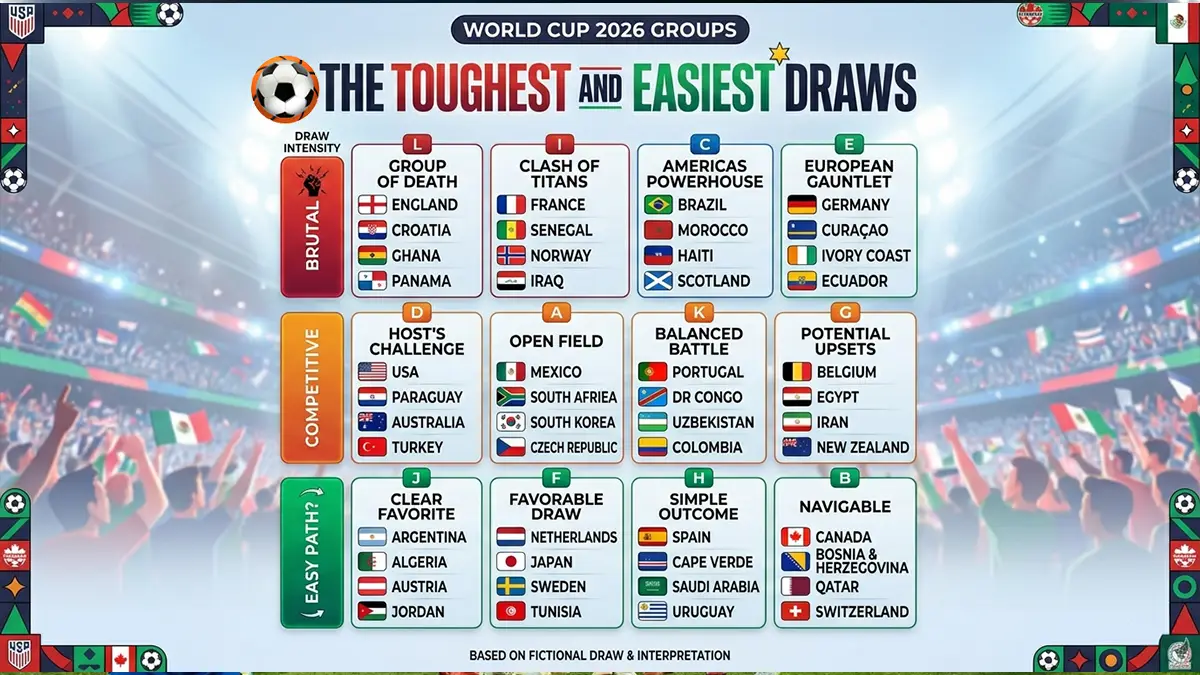
| Group | Teams |
|---|---|
| Group A | Mexico, South Africa, South Korea, Czechia |
| Group B | Canada, Bosnia and Herzegovina, Qatar, Switzerland |
| Group C | Brazil, Morocco, Haiti, Scotland |
| Group D | USA, Paraguay, Australia, Turkey |
| Group E | Germany, Curaçao, Côte d’Ivoire, Ecuador |
| Group F | Netherlands, Japan, Sweden, Tunisia |
| Group G | Belgium, Egypt, Iran, New Zealand |
| Group H | Spain, Cabo Verde, Saudi Arabia, Uruguay |
| Group I | France, Senegal, Iraq, Norway |
| Group J | Argentina, Algeria, Austria, Jordan |
| Group K | Portugal, DR Congo, Uzbekistan, Colombia |
| Group L | England, Croatia, Ghana, Panama |
What Makes a World Cup Group Tough or Easy?
Still, some draws are clearly harder than others on paper. A group becomes difficult when it has more than one top-level team, when the third team is also dangerous, or when the styles in the group make every match awkward. A team may be stronger overall, but if the opponents are organized, physical, or tactically uncomfortable, the draw can quickly become more dangerous than it first appears.
By contrast, a more manageable group usually has one clear favorite and fewer proven teams around them. Even then, those matches are not simple. It only means the path looks less dangerous compared with the worst draws in the tournament.
So this article is not trying to say one group is “easy” in an absolute sense. Instead, it compares the groups with each other and asks which draws look hardest and which look more favorable before the first ball is kicked.
The Toughest World Cup 2026 Groups
Group I: France, Senegal, Iraq, Norway
Senegal are one of the strongest African sides and have enough quality, pace, and tournament experience to trouble almost anyone. Norway may not be a traditional giant, yet with their attacking talent they are the kind of team nobody wants as a third opponent. Iraq may be viewed as outsiders, but they arrive with emotion and momentum after taking the final World Cup place.
The biggest issue here is that France are not the only team with real knockout-stage quality. Senegal and Norway both have strong reasons to believe they can qualify. Because of that, this is a very serious group from top to bottom. For neutral fans, it could be one of the most interesting sections in the whole draw.
Group L: England, Croatia, Ghana, Panama
England will still expect to qualify, but Croatia remain one of the most experienced and intelligent tournament teams in world football. Ghana add athleticism, intensity, and emotional edge. Panama may be the least fancied side, but they are not a team that simply rolls over, especially in group-stage football.
This is a group where rhythm will matter a lot. England and Croatia are the strongest teams on paper, yet neither should assume easy control. Ghana can make matches physical and tense, and that alone is enough to turn a calm-looking group into a stressful one.
So Group L may not be the clearest group of death, but it is definitely one of the trickiest draws because there are very few soft moments in it.
Group K: Portugal, DR Congo, Uzbekistan, Colombia
Colombia have the quality and tournament habit to challenge any seeded nation. Uzbekistan are one of the more interesting rising teams in the competition and will not be easy to break down. Meanwhile, DR Congo come in with real energy after their dramatic qualification and could make this group more difficult than many people think.
What makes Group K dangerous is that it does not have a clear weak team. Even if Portugal are favorites, the battle behind them looks very open. As a result, every result could change the table quickly.
For Portugal, this is not a terrible draw, but it is not relaxed either. Colombia, in particular, make this group much tougher than it may look at first glance.
Group F: Netherlands, Japan, Sweden, Tunisia
The Netherlands will start as favorites, but Japan are disciplined and technically strong, Sweden arrive after a dramatic qualification run, and Tunisia are usually difficult opponents in tournament football. In other words, this does not look like a group where one team can cruise through with very little resistance.
The real danger here is balance. Group F may not produce the biggest headlines, but it could be the kind of section where all four teams remain alive deep into the group stage. That usually creates pressure and messy table math late on.
If you are a neutral fan, this could be one of the best groups to watch because every game feels capable of shifting the whole picture.
The More Manageable World Cup 2026 Groups
Group J: Argentina, Algeria, Austria, Jordan
Austria are organized and can make life difficult, but they are not the kind of second seed that immediately makes the group feel dangerous. Algeria have quality, but they are also in a section where they may struggle to control matches against stronger opponents. Jordan deserve great respect just for reaching this stage, but on paper they are the side most people will place fourth.
That is why Argentina should feel good about this draw. It is not a free pass, but it does not look like one of the tournament’s most stressful sections either.
Group G: Belgium, Egypt, Iran, New Zealand
Egypt and Iran are solid and experienced teams, but neither immediately gives this section the feel of a heavyweight collision group. New Zealand will be aiming to compete hard, but on paper they are the least threatening side in this group.
What helps Belgium most is that there is no obvious second giant in the draw. The group may still be awkward because Egypt and Iran can both stay compact and disciplined, but compared with some of the more dangerous sections, Group G looks friendlier.
Because of that, this is the kind of group where Belgium should believe they can take control early if they start well.
Group A: Mexico, South Africa, South Korea, Czechia
Mexico, as hosts, will be pleased enough with this draw. South Korea and Czechia are serious opponents, and South Africa can make things difficult, but there is no team here with the profile of a France, Spain, Brazil, or England.
That could make Group A one of the most balanced sections in the tournament. At the same time, balance can sometimes work in the favorite’s favor if they handle pressure better than the others. Mexico will likely see this as a group they can navigate, even if they will need to work for every point.
For the neutral, this looks less like a group of death and more like a group where several teams will believe qualification is realistic.
Which Teams Should Feel Best About the Draw?
You could also make a case for Germany in Group E. That group is not as easy as it may first appear because Ecuador and Côte d’Ivoire can both create problems, but it is still not as intimidating as the worst sections in the draw.
In short, the teams that should feel best are not necessarily those with weak opponents. Rather, they are the ones who avoided a draw with two or three proven high-level threats in the same section.
Which Teams Have the Most to Worry About?
The team that may feel especially uncomfortable is Norway. They are good enough to dream of qualification, but landing in a group with France and Senegal is a brutal challenge. Sweden could feel something similar in Group F, where even a solid team can still find itself trapped in a very balanced group.
That is why the draw matters. It does not remove quality, but it changes the margin for error. Some teams can afford one shaky match. Others may feel that the pressure starts immediately.
Final Thoughts
If you are looking for the hardest groups, Group I, Group L, Group K, and Group F all have strong arguments. If you are looking for the more manageable draws, Group J and Group G stand out first, with Group A also looking more open than many others.
Of course, World Cup football always gives us surprises. A group that looks easy in April can feel completely different in June. Injuries, form, confidence, and one big result can change everything very quickly.
Still, first impressions matter, and this draw has already created several clear storylines. You can follow more tournament coverage in our World Cup 2026 section.










 hamkam2xr
  salahsyh2xr
  quqi2xr
  blagoyp
  maraskino
  tennizexpert
  scorpio
  josebook











 *Odds – Are not always accurate and can change.

You must be logged in to post a comment.